Autumn or Fall, which do you call it? For me, it’s Fall and time for sweater and boot weather and time for the leaves to turn bright colors and time to bring out the pumpkins! So, I thought it would be a good time to share a Pumpkin project with you!
This week we are going to use lots of different supplies.

I love to try out new supplies, and this project, we will use lots of fun supplies. Have you used Modeling Paste? It will be the base for our project and add a textured effect to our Pumpkin. Then we will add a little paint, some glass, and Resin. So, let’s get started.

SUPPLIES
- Canvas 4×4, I like to use Gallery Wrapped Canvas because they are 1 ½ inch thick.
- Acrylic Paint, I used Pumpkin, Kaki, Hauser Medium Green, Burnt Umber
- Liquidtex Modeling Paste
- Liquidtex Medium Slo-Dri
- Glass
- Art Resin
- Gloves
- Plate Knife
- Tracing Paper
- Pumpkin Tracer
- Tape
- Chip Brush
- Paint Brush
*Disclaimer: Links above are affiliate links. By clicking on these links I may earn a small commission at no cost to you. Some products may have been provided to me by vendors, however, all opinions and reviews are strictly my own.
Check out the video tutorial below or follow the step by step instructions below! You choose how you want to learn to make this project!
Step #1 Modeling Paste and Background
Whenever I add Resin to a piece, I like to tape off the bottom of my canvas first. This step will help protect the bottom of the canvas from resin drips.

Then the next thing I’m going to do is add modeling paste to give the background some texture. Just add a thin coat and use your pallet knife to spread the modeling paste all over the canvas, adding some swirls to add texture to the canvas in the corners. When you are satisfied with the background let the modeling paste dry.

Step #2 Painting Background
Next I paint the background. I am using Americano Hauser Medium Green. Use your paintbrush and paint over the dried modeling paste, and I also like to paint all four sides. Then let the background completely dry.


Step #3 Modeling Paste and Pumpkin
After your canvas dried, trace the pumpkin outline onto the canvas using the Pumpkin picture and tracing paper.

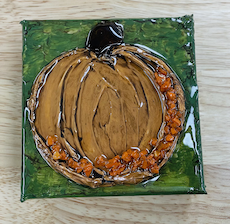
Once you have your Pumpkin traced out, start by applying a thick layer of the modeling paste on top of your traced Pumpkin.

Now start sculpting out your Pumpkin with the palette knife. I like to make the definition of the Pumpkin thick so you can see the lines. Don’t overthink it, have fun!

Now let your Pumpkin dry thoroughly. I like to let mine dry overnight.
Step #4 Paint Pumpkin
Now let’s paint! I like to mix Pumpkin and Kaki paint, but you can use any orange color for your Pumpkin.

Step #5 Apply Liquitex Slo-Dri Medium

Now for the fun stuff. This adds shadowing to my project. I add some of the medium to my paper plate or tray, and then I add a small amount of Burnt Umber Acrylic paint.
I would guess it is about an 80 to 20 mix. You can even mix a more significant amount and keep it ready for your next project in a container with a lid. That way, you are prepared for your next project.

Now it is time to take the mixture and apply it to our Pumpkin. I like to use a chip brush to apply my mixture. You want to add the mixture to the Pumpkin generously.

Since this is a small canvas, I cover the entire area along with the sides. If it were a larger canvas, I would do a section at a time.
Using a rag, begin removing the excess medium from the sides and top of the Pumpkin.

I like to pull in one direction, either down or up on the Pumpkin. I like to leave the medium next to each of the edges of the Pumpkin. The medium will dry and leave a shadowing effect on the Pumpkin. Remember, there is no right or wrong among of medium to remove or leave.

You decide what you like, and then it is time to let it dry!
Step #6 Adding Glass
Once the Pumpkin is dry, it is time to add some glass.

This step is optional. If you don’t want to add glass, you can skip to the Resin step. I did not have any orange glass on hand, so I spray painted some clear glass. I had recently broke a brown beer bottle, and I found a perfect piece to use on the stem. You can decided the amount of glass you want to add.

I used a small amount of glass for my Pumpkin because I just loved how the Pumpkin looked with the Liquitex Slo-Dri Medium on my Pumpkin. You can decide how much glass you want to add. Place the glass where you want it on the Pumpkin and get ready to add Resin!
Step #7 Add Resin
Now it’s time for Resin! Whatever Resin you choose to use will have the direction to follow for mixing the Resin. I like to use ArtResin. I always wear gloves when I am mixing Resin. Make sure that your surface is covered before mixing or pouring the Resin. I also elevate my project to allow the Resin to run free from the canvas during the drying time. You also want to make sure that your piece is in an area that will be undisturbed for at least 12 hours for drying.

You will only need a small amount of Resin for this project, about 10mm of Resin worked for this Pumpkin. I used 5mm of the Hardener and 5 mm of the Resin. I like to use three cups when I mix my Resin. In one cup, measure 5 mm of Hardener and in one cup measure 5 mm of Resin, and then in the third cup, combine the Hardener and Resin and mix. The ArtResin brand of Resin that I use instructs you to mix the mixture for 3 minutes. I like to mix slow and make sure that I am wiping around the sides, and I mix.

Once the Resin is mixed, I like to use a popsicle stick to drizzle resin over the top edges of the glass. This step will make sure that the glass is covered well.

Then I drizzle the rest of the Resin over the remaining canvas.

You can use your gloved hand, or I use a makeup applicator to spread the Resin.

Once you are satisfied that your canvas is completely covered with Resin, I like to take a heat gun and use it for popping any air bubbles.

Applying Heat to Resin Tips
There are a few things you want to remember when you are applying heat to your Resin. The heat is for popping air bubbles. Make sure to keep the heat 4 to 6 inches from the Resin. Always remember to keep your heat moving. Don’t hover over any one area. There is a chance you can burn the Resin.
Now it is time to step back and let the Resin dry. Check back in the morning, and your Resin should be dry. The directions on the Resin will tell you the timing of cured Resin.

Once you try a small project your can try a larger project like I did. I love my sunflowers that I have on my wall. They are 4-12X12 inch canvas!

If this project inspired you, then check out some of my other projects for more inspiration!
Don’t forget to checkout my Fun Stuff Crafts Amazon Storefront!
Social Media Links
CLICK HERE If you would like to join the Facebook Group, Crafts and Inspiration hosted by Fun Stuff Crafts! In the group, I share and encourage members to share tips and projects. Please answer the questions to be added to the group!
